
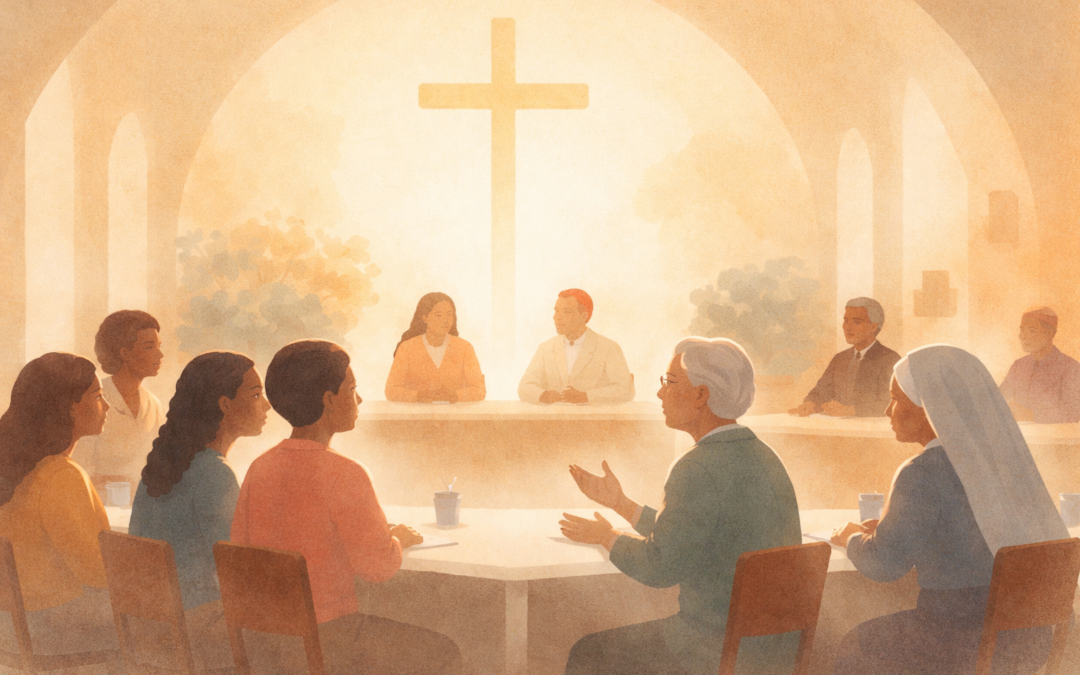
Women carry a large part of the daily life of the Church. They teach the faith to children, accompany the sick, organize parish life, keep communities alive in places where priests are few. In many parts of the world, if women disappeared from parish life on Sunday morning, very little would remain. And yet, when the Church gathers to discern and decide, women have often been missing from the table. This tension is the starting point of a recent reflection by Sister Nathalie Becquart.
Original article by Sister Nathalie Becquart: https://www.la-croix.com/a-vif/exclure-les-femmes-des-processus-decisionnels-de-l-eglise-cest-appauvrir-le-discernement-ecclesial-20260306
In an article published by La Croix 6 Mar 2026, Sister Nathalie Becquart reflects on what happens when women sustain so much of the Church’s lived reality while remaining absent from many places where decisions take shape. Her central argument is clear: excluding women from decision-making weakens the Church’s capacity for discernment.
She situates this reflection within the path opened by the Synod on Synodality. The final document approved by Pope Francis in October 2024 calls for a conversion of hearts, relationships, processes, and bonds. Within that framework, the relationship between men and women becomes part of the Church’s own conversion. The question is not only organizational. It touches how the Church listens to the Holy Spirit through the People of God.
One of the strongest points in Becquart’s article is the paradox she names. Women are present everywhere in the life of the Church: in pastoral work, education, prayer groups, charity, and community leadership. In many places they are the majority of those who keep parish life moving. Yet they are still often excluded from the processes where discernment and governance take place. Many reports during the synodal process described this gap using words such as clericalism and sexism.
At the same time, the synodal journey itself has opened new experiences. In the recent synodal assemblies, women participated not only as observers but also as voting members. For Becquart, the most meaningful change is the experience of men and women sitting at the same table, listening and discerning together. That shared space can slowly change mentalities and open new possibilities for responsibility within dioceses and pastoral structures.
Her reflection also moves beyond internal Church questions. She notes that the participation of women in peace processes and public decision-making often leads to more sustainable outcomes. The question therefore touches both the Church and society. It concerns dignity, justice, education, and the way communities learn to work together.
The article ends with a tone of sober hope. Some steps have been taken, yet the journey remains unfinished. Canonical questions are still open, including the ongoing discussion around women’s diaconate. For Becquart, the path forward lies in strengthening reciprocal listening between women and men so that the Church’s discernment becomes fuller and more faithful to the Gospel.
—
Becquart’s article does not focus on specific appointments or institutional changes. Its concern is broader: it describes a pattern in the Church and invites a deeper conversion of relationships. Still, her reflection makes even more sense when read within the wider developments of recent years.
Under Pope Francis, several steps gave the conversation a concrete institutional dimension. In 2021, the motu proprio Spiritus Domini opened the instituted ministries of lector and acolyte to women. In 2022, the apostolic constitution Praedicate Evangelium clarified that lay women and men can preside over dicasteries of the Roman Curia according to the nature of the office.
Alongside these reforms came a growing number of women appointed to positions of responsibility in the Church. A few examples illustrate this shift. Sister Nathalie Becquart herself serves as Undersecretary of the Synod of Bishops and participated as a voting member in the synodal assembly. Sister Simona Brambilla was appointed Prefect of the Dicastery for Institutes of Consecrated Life and Societies of Apostolic Life. Sister Raffaella Petrini was appointed President of the Governorate of Vatican City State. Sister Tiziana Merletti was appointed Secretary of the Dicastery for Consecrated Life. Laywoman María Lía Zervino became a member of the Dicastery for Bishops.
This list could continue. Women such as Linda Ghisoni and Gabriella Gambino hold leadership roles within the Dicastery for Laity, Family and Life. Others serve as consultors, secretaries, or members of Vatican bodies and diocesan leadership structures across the world. These examples are only a partial snapshot of a much broader movement.
What matters is not simply the number of appointments but the signal they send. These developments show that the conversation about women’s participation is no longer confined to theoretical debates. It is beginning to shape structures, responsibilities, and forms of governance.
So far, Pope Leo XIV appears to be continuing this direction. Recent appointments of women to Vatican offices and advisory bodies suggest continuity rather than reversal. That continuity matters. It indicates that the growing involvement of women in the life and discernment of the Church is being treated as part of a longer path rather than a temporary initiative.
Seen in this light, Becquart’s reflection becomes easier to understand. The Church already knows, through experience, that when women and men listen, speak, and discern together, the horizon widens. The task now is to allow that experience to shape more and more of the Church’s life.
Women have long stood at the heart of Christian communities. The question raised by Becquart is whether that reality will increasingly be reflected in the places where the Church listens, discerns, and decides. The steps taken in recent years suggest that the path, though unfinished, is already underway.